Technologies behind our cables
- Technologies behind our cables
Technologies behind our cables
Our cables are built on carefully selected materials and advanced engineering solutions that ensure durability, signal integrity, and outstanding performance. From conductor design to insulation technologies, every detail is optimized to deliver reliable audio and long-lasting quality.
Pressing instead of a screw clamp
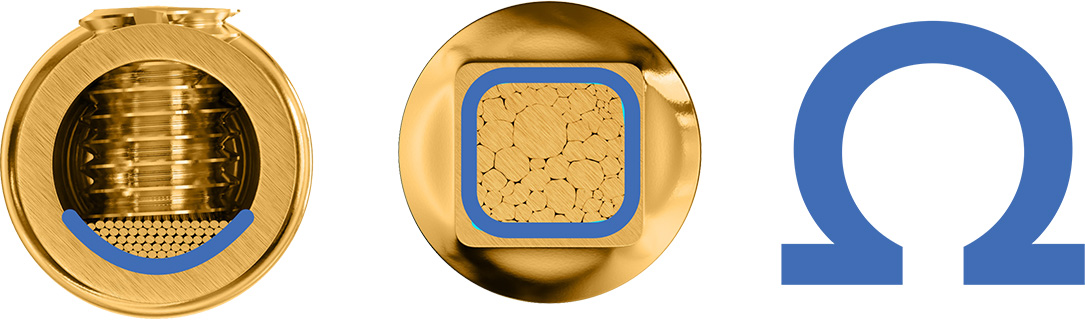
Solid Grip secures the conductor inside the plug by mechanical compression, without screws or solder. This creates a firm, stable termination that is resistant to oxidation and maintains reliable contact over time.
When connecting loudspeakers and audio amplifier with a bare wire causes the exposed copper to oxidize quickly which increases the cable resistance and has a detrimental effect on the fidelity of the sound we hear. That is why high-class cables rely on f.e. banana plugs. A special technology for tight connection of the plugs to the speaker cable without the use of soldering - Solid Grip Technology. Contrary to the standard connection technique, i.e. with the use of screw terminals, Solid Grip Technology involves crimping a properly prepared plug on the loudspeaker cable with a press. This allows all conductors to be tightly pressed together with the plug in a way that eliminates gaps between them and maximizes the contact area.
The monolith obtained this way forms a smooth, uninterrupted signal path, which significantly reduces the connection resistance. The cable and plug pressed into one unit using Solid Grip Technology offer a much higher conductivity than a terminal made with screws or soldered joints. Using this solution results in a reliable, durable connection that is resistant to oxidation and offers excellent electrical conductivity with reduced resistance.
Different thicknesses of conductors for low, medium and high tones
Conductors with different cross sectional areas within one cable. This design helps reduce the influence of skin effect and supports balanced current handling across the audio band.
Multi-Gauge Core Technology is the special cable construction which employs conductors of different thicknesses for low, medium and high tones. The thickness of individual conductors has been adapted to the specific cable types.
-
The thickest core for deep bass, e.g. organ, double bass or cinema effects
-
Medium-thick wires for full bass range, its proper control and selectivity
-
Medium wires for a saturated sound of a med range, e.g. guitar, piano, saxophone
-
Medium-thin wires for violin, celestial and vocal resonance
-
The thinnest strands for clean and accurate transmission of the highest frequencies
Braids in separate insulation twisted together
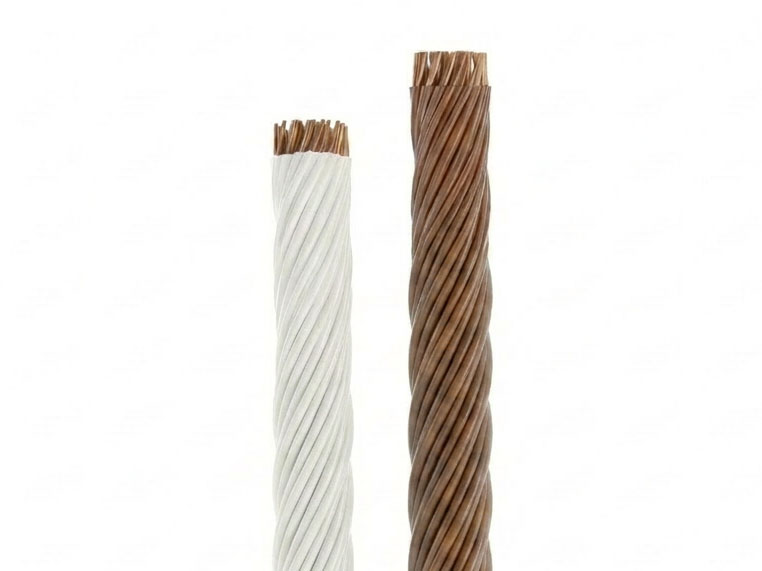
Spiral Litz construction uses individually insulated strands to reduce conductor interaction and support more even current flow. The insulation also helps protect the copper surface from oxidation over time.
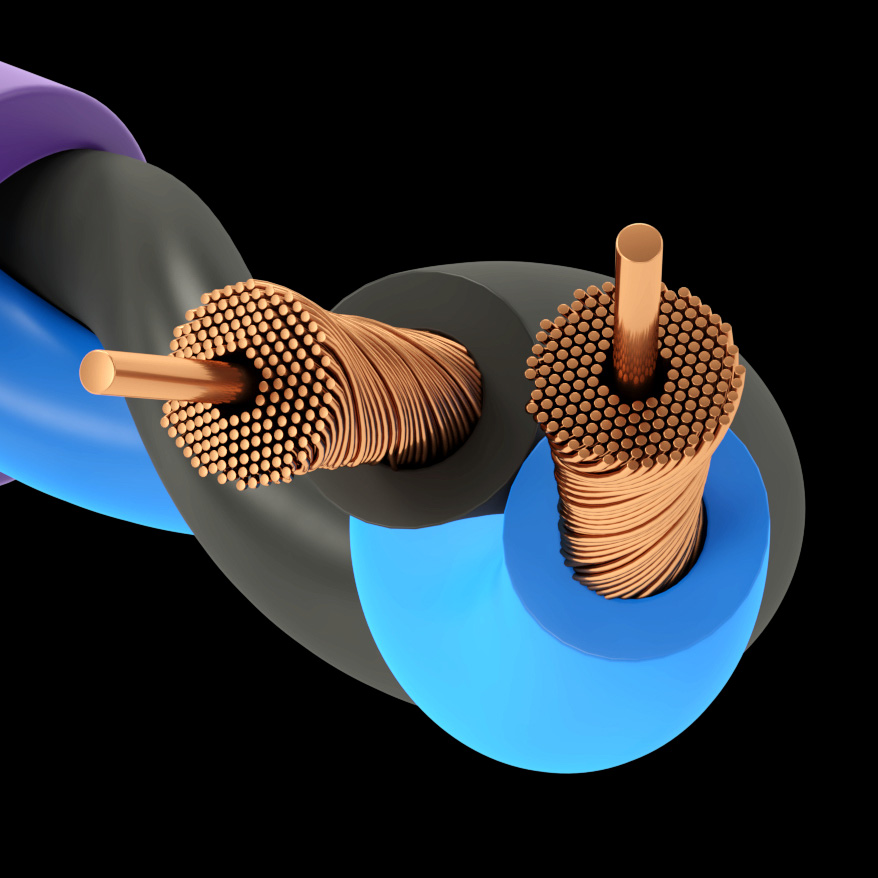
In Melodika cables, the individual conductor braids are placed in separate insulation and twisted together. As a result, the total current located on the power amplifier output flows in each core. The advantage of this solution over standard stranded cables is the even distribution of the signal across the entire cross-section of the cable. It also prevents the loss of the so-called subtle information, which occurs when electrons jump from strand to strand. The electrons follow their own path, without interruptions, and the skin effect is virtually eliminated. In addition, the fact that the conductor is separately insulated and twisted protects the copper against oxidation and increases the durability of the wire.
TWISTED CONDUCTOR GEOMETRY
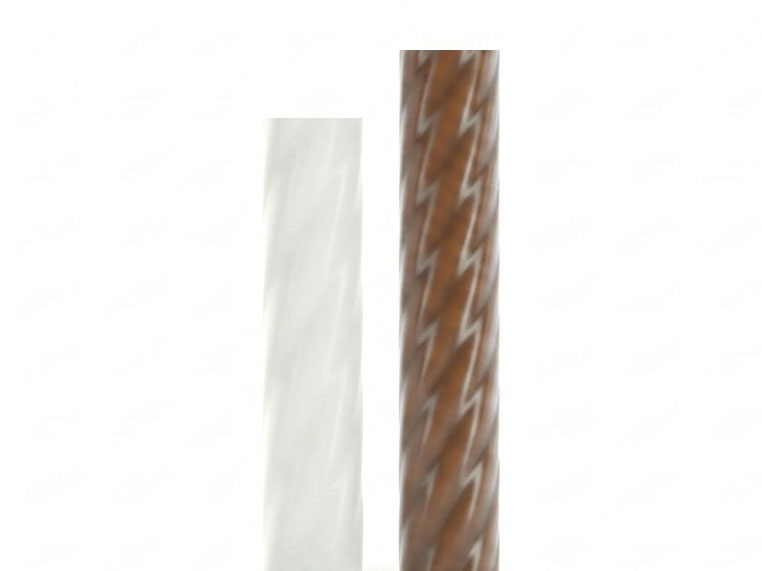
Helically twisted braid to eliminate self-interference
Twisted conductors keep the signal paths close together, reducing loop area and helping limit interference along the cable run.
Two braids of intertwined conductors eliminate self-interference. The use of a helically twisted braid (pigtail) means that the cable's sensitivity to interference is low. The current induced in one conductor has the opposite direction to that induced in the neighbouring conductor - so that interference cancels each other out. This solution was promoted by Alexander Graham Bell (scientist, inventor of the telephone and dozens of other telecommunications inventions), who in 1881 proved that this method of arranging the conductors reduces the impact of EMI interference and mutual interference called crosstalk.
Low-capacitance dielectric insulation
Low-Density Polyethylene Foam uses microscopic air cells to lower the effective dielectric constant. This helps reduce cable capacitance.
The low-capacitance dielectric insulation made of LDPE (foamed low-density polyethylene) protects against mechanical damage. The outer insulation of increased resistance means that the cables can be laid under plaster or concrete without fear of damaging the cable.
For better conduction of low frequencies
BassCore is a dedicated large gauge conductor that increases current capacity and lowers cable resistance during demanding Iow frequency passages.
Our research has shown that a cable with a bass core transmits Iow frequencies better. Therefore, while constructing the loudspeaker cables of the various series, BassCore Technology was used - a bundle of fine conductors, usually 0.15 mm thick, surrounds a thick core, the so-called "BassCore". Depending on the model, the structure of the conductor in the cables varies in thickness. The balanced construction makes the cable sound excellent across the full bandwidth spectrum, with a slightly warmed and deeply diving low range.
Guarantees high efficiency of audio signal transmission
Polish copper selected for its high purity and excel-lent conductivity. It provides a reliable material base for low loss cable design.
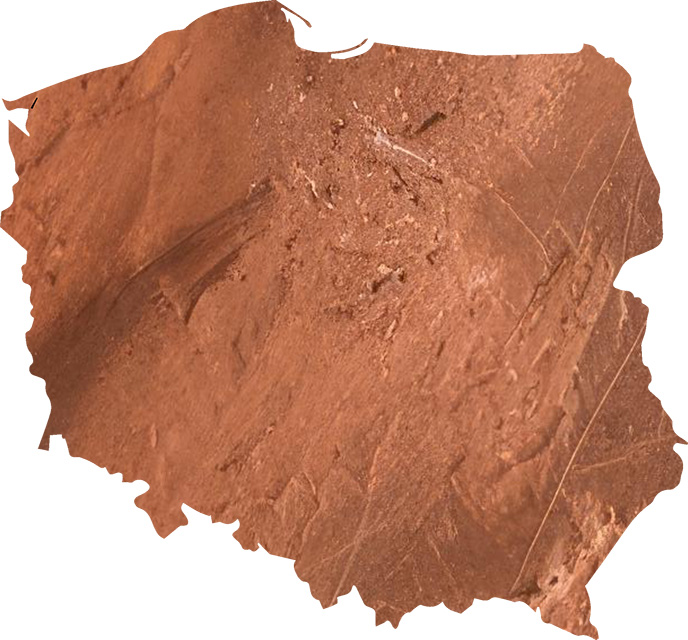
Copper is one of the best conducting materials under normal atmospheric conditions. It has low electrical resistance, which means it can effectively transmit electrical signals such as sound. The Polish copper which we use to create Melodika cables, is a guarantee of high product quality and high efficiency of audio signal transmission.
The use of Polish copper is also a matter of ecology - using local resources helps to minimize the carbon footprint. In addition, KGHM Polska Mied± S.A., our supplier of this raw material, complies with international environmental standards, implements eco-efficient and low-emission technologies and ensures standards aimed at protecting the health of residents and natural resources in the region.
Provides excellent insulation and exceptional durability.
Plugs use PTFE insulation for high thermal stability, chemical resistance and low dielectric loss. It helps maintain insulation quality over long term use.
The insulation of the plugs is made of a special material (polytetrafluoroethylene) resistant to temperatures up to 3200C, which is also characterized by exceptional chemical resistance (it does not react even in concentrated acid). The plugs constructed in this way guarantee excellent insulation and exceptional resistance. The predicted connection cycle for Melodika plugs is over 2000 cycles. When the cable is soldered, the insulation is not overheated and thus the plug construction is not affected in even the slightest way, so the transmitted signal is not disturbed in any way. Furthermore, the PTFE-type insulation does not store electrostatic charge - making it an excellent insulator.
High resistance to any interference
A high coverage copper braid helps protect the signal from electromagnetic interference. In selected models, metallised Mylar foil adds an additional shielding layer for improved effectiveness.
Shielding braid made of copper with a high percentage of coverage ensures very high resistance to any interference. To further increase the shielding effectiveness, a layer of metallised Mylar film is used on some models to ensure 100% coverage. Due to its higher thickness, the braided copper conductors absorb more EMI (ElectroMagnetic Interference), especially at lower frequencies. he second layer of shielding is formed by Mylar foil, which, being thinner, absorbs less interference but offers better protection over a wider frequency spectrum.